

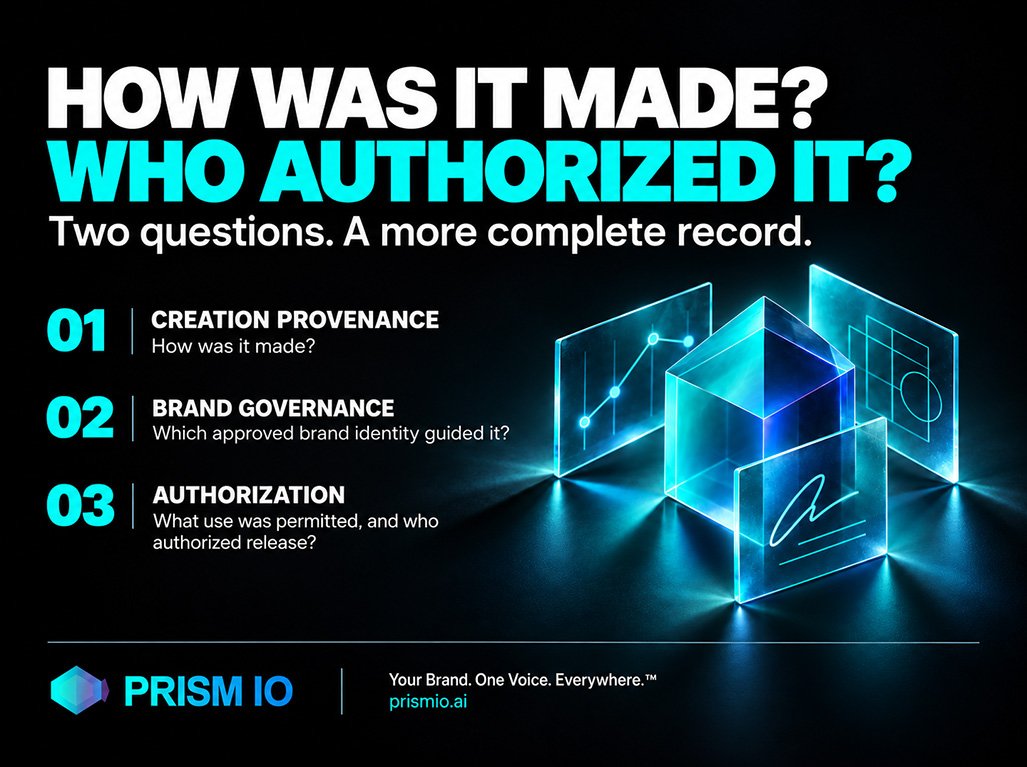
AI can tell us more about how digital work was created. Organizations also need to know which approved identity, permissions, and human authority governed how they were represented.
Quick Read
AI provenance can help us understand how digital work was created and changed. For companies, there are two more questions that matter just as much: What brand guided the work, and who had the authority to release it? Together, creation provenance, brand governance, and human authority create a more complete operating model for AI.
AI gives us extraordinary power to scale what we create. Marketing teams can develop more campaigns, sales teams can prepare more personalized communication, customer teams can respond faster, and agencies and studios can explore more ideas across more channels. That is an extraordinary opportunity for companies of every size.
But as AI becomes part of how your company communicates and represents itself, one question becomes more important:
What is all of that intelligence creating from?
Once the work is created, there is another question leaders should be able to answer: Can the company understand how the work was made, what brand guided it, and who had the authority to release it? That is where the conversation around AI provenance becomes especially important.
Provenance helps us understand the history of digital work. For a company, that history is valuable, but it is only the beginning. As AI becomes more deeply connected to how organizations communicate, I believe leaders should think about three questions together:
- How was it made?
- What brand guided it?
- Who had authority?
Those three questions create a much more complete picture of how AI-assisted work moves through a business.
Provenance gives us the history of the work
The idea behind provenance is familiar. We use it to understand the history of art, trace products through supply chains, and maintain records in manufacturing, finance, research, and intellectual property. Digital provenance brings the same principle into modern digital work.
For an image, video, document, audio file, or other asset, provenance can help preserve information about where it came from, which tools participated, what changed, and how the work developed over time. This becomes increasingly valuable because digital work often moves through multiple people, tools, teams, agencies, and publishing environments before anyone sees the final version.
The Coalition for Content Provenance and Authenticity, known as C2PA, has developed an open technical standard called Content Credentials. It provides a way to associate cryptographically verifiable provenance information with digital assets. The C2PA specification describes how information about an asset’s history, including creation, edits, participating actors, and other provenance data, can be recorded and made available across participating systems.
This matters because digital work rarely stays inside one tool. An image may begin in an AI model, be edited by a designer, adapted by an agency, localized by a regional team, prepared for another format in a different application, and eventually published somewhere else. Content Credentials can help preserve the chain of creation as that work moves.
That is valuable visibility.
For a company, however, creation history leads to another set of questions.
Knowing how something was made is only the beginning
Imagine that image is part of a global campaign for your company. You may be able to understand which AI system participated, which application edited the image, and when those changes occurred. But the people responsible for the brand will also care about what guided those decisions.
Was the team working from the current positioning? Were the approved product claims used? Was the message designed for the right audience? Did the agency and the internal team receive the same brand direction? Were the correct visual assets available? Did someone make an exception, and if so, who had the authority to make it?
Those are different questions from how the asset was created. They are questions about what the organization intended the work to represent.
That is where brand governance enters the picture.
I have spent more than 25 years working across brand, marketing, design, and technology, and one thing has remained consistent: a brand has never been just a logo, a color palette, or a set of writing rules. Your brand carries what you believe, who you serve, what you value, how you communicate, what you are willing to say, and how you want people to remember and feel about your company.
As more of that expression moves through AI, that brand context needs to be able to travel with the work.
Three layers create a more complete record
I think about this as a three-layer model. Each layer answers a different business question, and together they give leaders a clearer view of how AI-assisted work was created, governed, and released.
| Question | Layer | Business meaning |
|---|---|---|
| How was it made? | Creation provenance | Origin, tools, changes, AI involvement, and asset history |
| What brand guided it? | Brand governance | Identity, audience, claims, assets, policies, permissions, and standards |
| Who had authority? | Human authority | Review, decisions, approval, exceptions, and release |
Creation provenance gives you history. Brand governance gives you the context and standards that guided the work. Human authority establishes who remained responsible for consequential decisions.
You want all three because an asset can have a clear creation record and still use the wrong product message, an outdated claim, the wrong brand expression, or content intended for a different audience. It can also travel through an efficient AI-assisted workflow without anyone being clear about who had the authority to make the final decision.
Provenance, brand governance, and human authority are part of the same operating model. Provenance helps us understand the creation of digital work. Brand governance helps us understand how the organization was represented. Human authority completes the picture by making responsibility clear.
Think about a global campaign
Imagine your company is preparing a global campaign. Your internal strategy team develops the idea, product marketing provides the positioning and product claims, and an agency begins creative development. AI tools help generate concepts, images, video, and copy. Legal reviews the campaign, regional teams adapt it for local markets, another market changes the offer, and an executive reviews the final concept.
Everyone may be doing their job well. The difficulty is that every handoff creates another place where brand context can be interpreted, changed, or lost. As the campaign moves, people may be working from different documents, different prompts, different revisions, or different understandings of what has already been approved.
Six months later, someone asks why a particular claim appeared in the campaign. The organization may need to determine which positioning version the agency used, whether legal reviewed that specific copy, whether a regional team changed the message, whether an older product claim reappeared, and whether the final image was the same version originally reviewed.
For many organizations, reconstructing that story means searching through presentations, email, Slack, shared drives, prompts, agency folders, project-management systems, and people’s memories. That approach can work while the number of outputs and participants remains manageable.
AI changes the scale.
As more people, tools, regions, agencies, agents, and AI systems participate in a company’s communication, the organization benefits from having a practical way to understand what happened when consequential work is created, reviewed, and released.
A leadership team should be able to ask:
- What brand identity guided this work?
- Which version of that identity was current?
- Which claims, assets, policies, or restrictions applied?
- What changed during the workflow?
- Who reviewed the work and had authority to release it?
- Could we reconstruct the important decisions six months later?
These are not abstract governance questions. They are practical operating questions for any company that wants to increase the use of AI while remaining clear about how the organization is being represented.
AI transparency is becoming operational
The wider AI transparency environment is moving in the same direction. Article 50 of the EU AI Act includes transparency obligations for providers and deployers of certain AI systems. The European Commission published implementation guidelines on July 20, 2026, and the Article 50 transparency rules began applying on August 2, 2026.
Those obligations address areas such as direct interaction with AI, machine-readable marking of certain AI-generated or manipulated content, deepfakes, and certain public-interest content. The exact requirements depend on the system, the organization’s role, the content, and the use case.
The larger business point is straightforward:
AI transparency is becoming operational.
Organizations increasingly want to understand where AI participated, what should be disclosed, which processes were followed, and what record remains afterward. What once felt like a future governance discussion is becoming part of normal operating practice.
Advertising is moving in the same direction. On August 18, 2026, IAB published Version 2 of its AI Transparency & Disclosure Framework, which uses a risk-based, materiality-driven approach to help brands, agencies, publishers, platforms, and technology partners decide when and how AI involvement should be disclosed in consumer-facing advertising and marketing.
These developments help create a clearer record around AI involvement. They also raise a closely related business question: if AI is representing your company, what identity, standards, claims, policies, and human authority were guiding that representation?
Brand governance is becoming part of the AI operating model
Most companies already have a brand. They have messaging, policies, standards, customer understanding, product claims, assets, approvals, and people responsible for important decisions. The challenge is making that context useful when AI enters the workflow.
A brand system designed primarily for people to read can become difficult to apply when work moves through many AI tools, agents, teams, and automated workflows. Someone still has to determine which information is current, move the right context into the right tool, understand which standards apply, and remember which decisions have already been made.
That is why I believe the brand layer is becoming part of the AI infrastructure conversation.
The objective is not to make every piece of communication identical. Strong brands need range. A sales proposal should not sound like an Instagram post. A CEO letter should not sound like a support response. A studio trailer should not feel like a legal notice.
The opportunity is to let each expression adapt intelligently to the audience and situation while still coming from the same clear brand foundation. That is the role of brand identity governance.
Where Prism IO™ fits
Prism IO™ helps organizations define and structure their brand so people and AI can work from something more useful than scattered documents, prompts, and memory. Brand System Architect™ helps turn the company’s identity into a machine-readable Brand Identity System™ that can bring together the audiences it serves, how it communicates, its messages, claims, assets, policies, permissions, decision authority, review rules, and other standards that shape how the company is represented.
Content continues to be created in the AI tools and workflows the organization chooses. BrandOS™ provides the governance layer around that work by governing and tracing how the brand is represented across people, AI tools, systems, agents, and workflows.
An organization’s own policies and compliance requirements can also be built into its Brand Identity System™ alongside its brand standards, permissions, review rules, and decision authority. That makes those requirements part of the governed context available to AI-assisted work rather than leaving teams to repeatedly reconstruct them from separate systems and documents.
The organization remains in control of its identity. Technology can carry the context, governance can make expectations clear, and AI can help people create. The people responsible for the brand retain the judgment and authority required to decide what ultimately represents the company.
Provenance, brand governance, and human authority work together
Provenance is becoming part of how companies understand and govern AI-assisted work. C2PA Content Credentials help preserve verifiable information about how digital assets were created and changed. Prism IO™ extends that operating context into the brand itself by recording and timestamping the governed brand identity, policies, permissions, decisions, and human authority connected to how an organization is represented.
This creates a richer provenance record. Leaders can understand not only which tools participated and how an asset changed, but also which Brand Identity System™ guided the work, which standards and requirements applied, and who held authority for consequential decisions. Prism IO™’s approach to recording, traceability, and human authority also aligns with the growing transparency expectations reflected in Article 50 of the EU AI Act.
For organizations scaling AI, provenance, brand governance, and human authority are increasingly part of the same operating conversation. Together, they help answer three essential questions: How was the work created? What governed how our brand was represented? Who was responsible for the decisions that mattered?
That gives companies a clearer, more accountable record of how AI-assisted work came to represent their brand.
The business value is confidence
The business value is confidence.
Traceability can sound like a technical subject, but the outcome is very human. A brand leader can have more confidence that teams are working from the same foundation. An agency can know which client context should guide the work. A marketing team can understand which messages and claims were active. Legal and compliance teams can bring the requirements they own into the operating structure.
Technology leaders gain a clearer way to connect brand context to the AI systems being introduced across the company. Leadership can understand important work later without depending entirely on someone’s memory. The people responsible for the brand can spend more time making good decisions instead of repeatedly rebuilding the context required to make them.
That is what I want AI infrastructure to give companies: more clarity, more usable context, and greater confidence as they expand what AI makes possible.
Questions Leaders Are Asking About AI Provenance, Brand Governance, and Traceability
What is AI provenance?
AI provenance is the history of digital work.
It can show where an asset came from, which tools participated, whether AI was involved, what changed, and how the work moved through a digital workflow. For a company, that visibility becomes increasingly valuable as important work passes through more people, tools, teams, agencies, and systems.
Think of provenance as the creation history behind the work. It helps your organization understand how something developed before it reached its final form.
What are C2PA Content Credentials?
C2PA Content Credentials use an open technical standard for associating verifiable provenance information with digital assets.
They can carry information about an asset’s creation, edits, participating tools, and other parts of its history. For businesses, Content Credentials can make the creation history of important media easier to understand as it moves between participating applications and workflows.
Why does a company need more than creation provenance?
Creation provenance answers one important business question: How was the work made?
Organizations also want to understand what brand identity, messages, claims, assets, policies, permissions, and standards guided the work, along with who had responsibility for the decisions that mattered.
Together, those questions create a more complete picture:
How was it made? What brand guided it? Who had authority?
That is why provenance becomes more useful to a company when it is connected to brand governance and human authority.
What does brand governance add?
Brand governance connects the work to the identity and standards that should guide how your organization is represented.
That context can include your audiences, positioning, messages, claims, visual and verbal identity, assets, policies, permissions, decision authority, review rules, and other requirements that shape the work.
The goal is not to make every communication identical. A sales proposal should not sound like a social post, and a CEO letter should not sound like a customer-support response. The goal is to help each expression fit its audience and purpose while still coming from the same clear brand foundation.
How do provenance, brand governance, and human authority work together?
They answer three related questions.
Creation provenance explains how the work was created and changed.
Brand governance explains what identity and organizational context guided it.
Human authority establishes who was responsible for review, judgment, exceptions, approval, and release.
Together, these three layers give an organization a clearer operating model for AI-assisted work. You can understand not only what was created, but how it came to represent your company and who remained responsible for the decisions that mattered.
What does Article 50 of the EU AI Act mean for companies using AI?
Article 50 establishes transparency obligations for providers and deployers of certain AI systems and uses. Those obligations began applying on August 2, 2026.
For business leaders, the practical point is that AI transparency is becoming part of normal operations. Organizations increasingly need to understand where AI is involved, which transparency requirements apply to their circumstances, and how those responsibilities fit into everyday workflows.
The specific requirements depend on the organization’s role, systems, content, and use case. Legal and compliance teams can help determine what applies to a particular organization.
How does Prism IO™ support brand governance and traceability?
Prism IO™ gives organizations a clearer brand foundation for people and AI to work from.
Brand System Architect™ helps define and structure that foundation as a machine-readable Brand Identity System™. It brings together the audiences you serve, how you communicate, your messages, claims, assets, policies, permissions, decision authority, review rules, and other standards that shape how your organization is represented.
BrandOS™ governs and traces how that brand identity is represented across people, AI tools, systems, agents, and workflows. This gives the organization a clearer connection between the brand behind the work and the environments where that work is created and applied.
Where is content created, and what does BrandOS™ govern?
Content is created in the AI tools and workflows your organization selects.
BrandOS™ provides the brand identity and governance layer around that work. It makes governed brand context usable across people, AI tools, systems, agents, and workflows so teams can continue using the tools that fit the job while working from a clear shared foundation.
This allows your organization to expand its use of AI without having to rebuild its brand context for every new tool or workflow.
How can an organization include policies and compliance requirements in its Brand Identity System™?
An organization can bring its policies and compliance requirements into its Brand Identity System™ alongside brand standards, permissions, decision authority, review rules, and traceability expectations.
BrandOS™ applies that governed context across the AI tools and workflows the organization authorizes. This gives brand, marketing, legal, compliance, technology, and leadership teams a shared structure for the requirements they each own while keeping those requirements connected to how the organization is represented.
The result is a more connected way for the organization to carry its standards into AI-assisted work.
Where should a company begin?
Start with one important AI-assisted workflow. It could be a customer-facing assistant, campaign production, sales proposals, agency production, studio development, or executive communication.
Define the brand context that should guide the work, make sure people and AI tools can access current information, determine what should be traceable, and identify which decisions require human authority.
Then ask one question:
Could we understand the important decisions six months from now?
That exercise will quickly show you where your existing system is strong and where important brand context is still fragmented across documents, prompts, folders, systems, and individual memory.
That is where a Brand Identity System™ can create meaningful value.
Where should a company begin?
If I were responsible for this inside a company, I would start by making the brand clear enough to travel, then prove the system in one important AI-assisted workflow.
The practical path is:
1. Establish your current brand source
Bring together the identity your organization wants people and AI to follow:
- Purpose, beliefs, and values
- Audiences and customer understanding
- Positioning and core messages
- Voice and visual standards
- Approved claims and assets
- Policies, permissions, and review requirements
Resolve conflicting or outdated information. Identify the people who have authority over the brand. Give the resulting foundation an owner, version, and date.
This becomes the approved source for how your organization should be represented.
2. Structure the brand so people and AI can use it
Move the brand beyond documents that people must repeatedly interpret.
Turn the foundation into a structured Brand Identity System™ that makes the current identity, audiences, messages, standards, claims, policies, and authority clear to the people and AI tools doing the work.
The goal is simple: everyone should be creating from the same brand foundation.
3. Define governance and human authority
Decide how the brand should guide action.
Clarify:
- What AI can assist with
- Which claims and assets may be used
- What requires human review
- Who can approve exceptions
- Who has authority to release the work
- Which decisions should be preserved
This gives your team freedom to move while keeping responsibility clear.
4. Connect one important workflow
Choose a workflow where stronger brand context would create visible value.
It might be:
- A customer-facing AI assistant
- Campaign production
- Sales proposals
- Executive communication
- Agency production
- A studio or intellectual-property workflow
Make the current brand context available where the work actually happens. Give the people and AI tools involved access to the same identity, audience, message, claim, asset, and policy guidance.
Starting with one workflow makes the system practical, testable, and easier to improve.
5. Decide what should be traceable
Build the record while the work is happening.
For important work, preserve three connected forms of context:
- Creation provenance: Which tools, inputs, edits, and changes shaped the work?
- Brand governance: Which brand revision, audience, claims, assets, policies, and standards guided it?
- Human authority: Who reviewed the work, made exceptions, approved important decisions, and authorized release?
Some of that history may travel with a digital asset through standards such as C2PA Content Credentials. Other decisions may belong in the organization’s governance and approval records.
Together, they create a clearer account of how the work was made, what guided it, and who stood behind it.
6. Test the record before you expand
Select one completed piece of work and ask:
- Can we identify the source materials and tools involved?
- Can we identify the brand revision that guided it?
- Can we see which claims, assets, and policies applied?
- Can we identify the people responsible for important decisions?
- Could we reconstruct this process six months from now?
Where the answer is unclear, strengthen the system. Where it works, carry the pattern into the next workflow.
That is the practical starting point:
One approved brand source. One governed workflow. One traceable decision record.
Prism IO™ helps organizations build and operate this path. Brand System Architect™ structures the brand as a machine-readable Brand Identity System™. BrandOS™ governs and traces how that brand is represented across people, AI tools, systems, agents, and workflows.
Your organization remains the authority. Your AI gains a clearer brand foundation. And the decisions behind important work become easier to understand as you scale.
Unmistakably your brand.
Your Brand. One Voice. Everywhere.™
The bigger opportunity
I am optimistic about what AI makes possible for companies. It can help us explore more ideas, create across more formats, serve customers more intelligently, move faster across teams and markets, and give smaller teams capabilities that once required enormous resources.
The opportunity is to make sure that, as this intelligence scales, it has a clear understanding of who and what it is representing.
Provenance explains how the work was made. Brand governance explains what identity guided it. Human authority explains who remained responsible.
Together, those layers give companies a stronger foundation for scaling AI while preserving the identity, judgment, and trust that make a brand valuable.
Your brand remains yours.
Now you can give your people and your AI tools a clearer way to work from it.
